Motorola Tech Support

  • Subscribe to our RSS feed.
  • Twitter
  • StumbleUpon
  • Reddit
  • Facebook
  • Digg

Monday, 21 August 2006

What is Google's search share, really?

Posted on 20:15 by Unknown
It sounds like such a simple question. But like an impressionist painting, the closer you look, the more the image deteriorates.

ComScore says Google accounts for 44% of Internet searches in the US.
Netratings (owned by the Nielsen survey people) says Google's share is 49%.
Hitwise says Google's share is 60%.
Alexa
says Google's share is 85%.

What the heck is going on?

First of all, no one on Earth knows what Google's actual share is. In order to get that number, you'd have to know the exact number of searches conducted on every search engine on the Internet, and the search companies don't release that data. So various companies are using different methodologies to estimate the number.

Netratings and ComScore monitor panels of people who have web meters installed on their computers (similar to the way Nielsen measures TV ratings). Hitwise aggregates and weights the usage logs from ISPs. Alexa tracks web usage by people who have installed its toolbar.

The methodologies are different, but they shouldn't produce that much of a skew. Part of the disconnect may be due to differences in definitions. When is a search a search? Is it when someone goes to the search site, when they receive results from a search site, or when they actually click through on one of the results?

Alexa says it's measuring click-throughs. It's not clear what the other three are measuring, although I suspect that Netratings and ComScore are tracking searches conducted and not click-throughs. If either of them are just measuring visits to the search page, Yahoo's and MSN's traffic would be padded, because their homepages offer a lot more than a search box.

Even if Hitwise and Netratings are measuring actual searches, I guess it's possible that the average Google search generates more click-throughs than the average Yahoo search. That would explain the Alexa result – although I don't know why people would be more likely to click through on Google.

The disconnect is especially interesting to me because many weblogs report traffic that differs radically from the supposed search engine share. Many of them report more Google traffic than you'd expect from the ComScore and Netratings numbers.

(If you don't have your own website, I should give a little background – blog authors can get statistics showing where every visitor came from. We can't see who you are, but we can see which Internet domain you came from. If you used a search engine, we can see what query got you here and which search engine you used.)

The visitor logs for Mobile Opportunity show interesting trends from time to time. For example, my post on Adobe's plans to expand Flash into a platform got a fair number of readers from Adobe and Microsoft, but many more visits from the Yahoo corporate domain. Hmmmm. And for several months early this year, a lot of people at Motorola.com were searching online for the phrase "rokr failure."

As for which search engine generates the most traffic here, Google is the winner hands down, with 94% of the search engine referrals. MSN has 4%, and Yahoo only 2%. I don't know why that is. Maybe people looking for mobile-related information are more likely to use Google. Maybe Google drives more traffic toward weblogs in general, or specifically to Blogger-based weblogs (Google owns Blogger/Blogspot). Maybe people who do searches on Google are more likely to click through on the results.

Or maybe Google really is as dominant as Alexa says it is.

To test these some of questions, I did identical searches on Google, Yahoo, and MSN. I used "motorola rokr failure" as the search phrase because I knew Google ranked Mobile Opportunity high on that search.

Here are the top ten results for each:
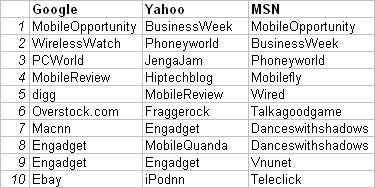


It's remarkable. No web page showed up in the top ten in all three search engines. There is almost no overlap between the top Google and Yahoo results, and MSN has a little bit of each. It's almost as if there were two separate Internets, one being indexed by Yahoo and the other being indexed by Google, with MSN trying to straddle them. I know that's not really the case, but clearly each of the search engines are using very different search algorithms.

I did a few other duplicate searches, and all showed the same sort of diversity. I couldn't spot any obvious biases in any of the engines – for example, Yahoo doesn't seem to be systematically excluding blogs. And I can't say that one search engine's results are objectively better than another's; they all found some good results and some clunkers (seriously, Google – you listed an Overstock auction when you didn't list BusinessWeek?)

So I don't know what's going on, other than that Yahoo's search engine doesn't like me.

I'm sure other people with more time and insight have investigated this issue. Please post a link if you know of a good article on the subject.

In the meantime, hello to all you searchers from Google, and I hope you found the information you needed.

Email ThisBlogThis!Share to XShare to FacebookShare to Pinterest
Posted in | No comments
Newer Post Older Post Home

0 comments:

Post a Comment

Subscribe to: Post Comments (Atom)

Popular Posts

  • Google Video: Is that all there is?
    Google's new video store seems to be up and running. I say "seems to be" because when I looked at it my first reaction was, ...
  • RIM's Pearl: Splendid hardware, unfinished software
    For me, the highlight of fall CTIA this year was that I finally got to play with a Pearl, RIM's latest smartphone. It has more media fe...
  • A new way to measure the popularity of the iPhone
    True story: Back when I was working at Apple, we received a report that there had been a burglary at a company that had a lot of Macintosh c...
  • "Social" as a Business Tool, and Richard Windsor Unchained
    I'd like to call your attention to two new information resources on the web. "Social" as a business tool.   First, my friend a...
  • Why Apple + RIM would be a bad idea
    Several days ago a financial analyst in Canada floated the idea that Apple and RIM might collaborate to create the merger of an iPod and a ...
  • What does Google want?
    I’ve been doing a lot of networking in the last couple of months, meeting new people and getting in touch with old friends and co-workers. I...
  • Mobile phones and navigation: I've seen this movie before
    Reuters published an article saying that navigation features are the hot new data function on mobile phones. News.com picked it up, and by...
  • Motorola Rokr: Instant Failure
    I did an online search today for the words “Rokr” and “failure” together in the same article. There were 49,700 hits. I don’t want to pic...
  • Look what's number one
    The image above was sent to me today by a former PalmSource colleague. Yes, that's a list of Amazon's best-selling consumer electron...
  • The river and the dam: CTIA and The Future of Web Apps
    I went to two conferences this week: the CTIA telephony conference in Los Angeles and The Future of Web Apps in San Francisco. It's al...

Categories

  • Adobe
  • Air
  • Amazon
  • android
  • Apollo
  • apple
  • applications
  • April 1
  • att
  • avatar
  • blackberry
  • cera
  • China
  • Chrome
  • clearwire
  • community
  • conference
  • content
  • convergence
  • ctia
  • design
  • developers
  • devices
  • digital chocolate
  • ebook
  • entertainment
  • eTel
  • foleo
  • GMR
  • google
  • HP
  • htc
  • IBM
  • influencers
  • info ecosystem
  • info pad
  • information overload
  • intel
  • internet
  • ipad
  • iphone
  • japan
  • kindle
  • linux
  • Logitech
  • metaplatform
  • Metro
  • microsoft
  • mobile
  • mobile data
  • mobilists
  • motorola
  • N95
  • nano
  • net neutrality
  • netbooks
  • new media
  • Nintendo
  • nokia
  • O'Reilly
  • O'Reilly TOC
  • operators
  • oqo
  • OS
  • Palm
  • PDF
  • platforms
  • Pre
  • PS3
  • psion
  • qualcomm
  • RIM
  • rubicon
  • samsung
  • search
  • security
  • semantic web
  • Silverlight
  • smartphone
  • smartphones
  • Sony
  • speech
  • sprint
  • symbian
  • tablet
  • traffic
  • treo
  • twitter
  • verizon
  • video
  • virtual reality
  • vista
  • web
  • Web 2.0 summit
  • web apps
  • webos
  • wimax
  • windows
  • Windows Mobile
  • yahoo
  • zekira

Blog Archive

  • ►  2013 (10)
    • ►  September (1)
    • ►  July (1)
    • ►  June (2)
    • ►  May (1)
    • ►  April (2)
    • ►  March (3)
  • ►  2012 (17)
    • ►  October (2)
    • ►  September (1)
    • ►  August (1)
    • ►  July (1)
    • ►  June (1)
    • ►  May (2)
    • ►  April (4)
    • ►  March (2)
    • ►  February (2)
    • ►  January (1)
  • ►  2011 (28)
    • ►  December (1)
    • ►  November (1)
    • ►  September (2)
    • ►  August (7)
    • ►  June (4)
    • ►  May (1)
    • ►  April (4)
    • ►  February (7)
    • ►  January (1)
  • ►  2010 (20)
    • ►  December (1)
    • ►  November (2)
    • ►  October (2)
    • ►  September (1)
    • ►  August (1)
    • ►  July (1)
    • ►  May (1)
    • ►  April (3)
    • ►  March (1)
    • ►  February (2)
    • ►  January (5)
  • ►  2009 (22)
    • ►  November (3)
    • ►  October (1)
    • ►  September (1)
    • ►  August (2)
    • ►  July (1)
    • ►  June (2)
    • ►  May (1)
    • ►  April (5)
    • ►  March (1)
    • ►  February (1)
    • ►  January (4)
  • ►  2008 (32)
    • ►  December (4)
    • ►  October (1)
    • ►  September (1)
    • ►  August (2)
    • ►  July (1)
    • ►  June (3)
    • ►  May (3)
    • ►  April (3)
    • ►  March (7)
    • ►  February (4)
    • ►  January (3)
  • ►  2007 (61)
    • ►  November (8)
    • ►  October (1)
    • ►  September (5)
    • ►  August (4)
    • ►  July (4)
    • ►  June (2)
    • ►  May (4)
    • ►  April (5)
    • ►  March (10)
    • ►  February (6)
    • ►  January (12)
  • ▼  2006 (73)
    • ►  December (7)
    • ►  November (4)
    • ►  October (7)
    • ►  September (6)
    • ▼  August (4)
      • Going to CTIA
      • What if Palm made a smartphone and nobody cared?
      • What is Google's search share, really?
      • What a difference three years makes
    • ►  July (4)
    • ►  June (7)
    • ►  May (5)
    • ►  April (8)
    • ►  March (6)
    • ►  February (6)
    • ►  January (9)
  • ►  2005 (22)
    • ►  December (9)
    • ►  November (6)
    • ►  October (7)
Powered by Blogger.

About Me

Unknown
View my complete profile